





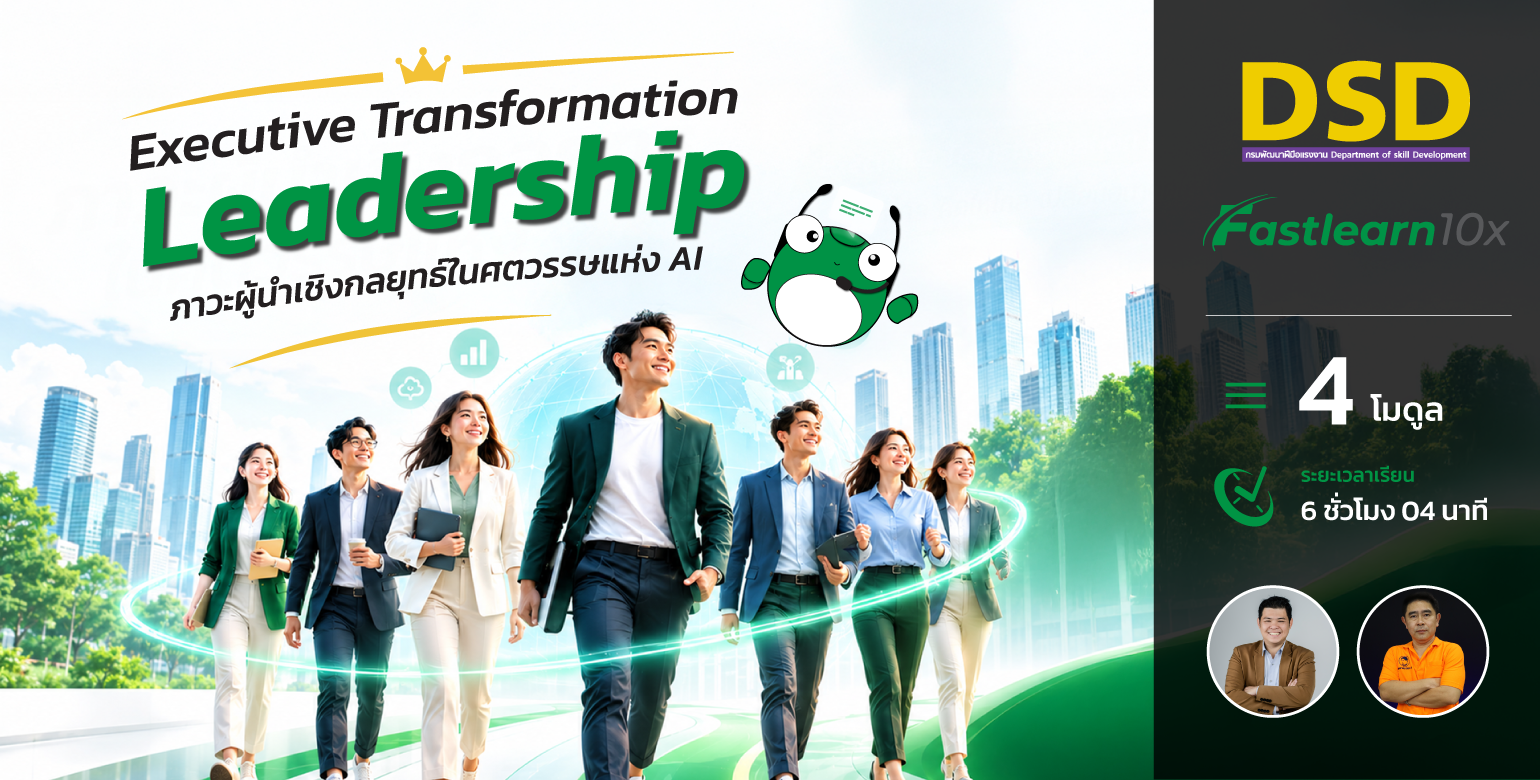
Strategic Leadership in the AI Century: Executive Transformation Leadership

- Description
- Curriculum
- FAQ
- Reviews
Instructor:
1. Yotsak Mongkolpanyalerd
2. Dr. Kritipong Dechsangcharas

The century of AI is rapidly transforming the way we compete, the way we work, customer behavior, and the expectations placed on organizational leaders. Simply being an experienced manager who can handle routine tasks effectively may no longer be sufficient.
The key challenge for managers today is not simply to ask: “"What can AI do?"” But it's about understanding which direction the organization should go, which technologies to invest in, which changes should be accelerated, and how to ensure that people, strategy, processes, technology, and data are all aligned to move in the same direction.
Many organizations have a vision but cannot translate it into execution; they have the technology but cannot create business value; they invest in AI but don't see a clear return on investment; or they start transformation but face resistance from people and limitations of the old system.
Strategic Leadership in the AI Century (Executive Transformation Leadership) It is therefore designed to empower executives to be able... Looking to the future, thinking strategically, understanding the potential of AI, managing organizations holistically, and driving change to real results.
The curriculum links four key competencies: AI Strategy, Visionary Leadership, Holistic & Systems Thinking and Change Management To help executives not only “keep up with the changes” but also to confidently set the direction and lead the organization through those changes.
The goal of the course is development. Executive Transformation Leader That can connect Vision → Strategy → People → Technology → Execution And it prepares organizations to compete and grow in the century of AI.
This course requires authorization under an organizational contract. Please contact the administrator.

-
1
 Download the learning material: AI Strategy For Executives: Transforming Business Strategy with AI.
 -
2
 Lesson 1: AI Strategy vs. Tech Trends: Why AI is no longer just about IT, but also about Business Strategy.
 -
3
Lesson 2: The AI Value Matrix - How to evaluate and select the use case that provides the highest ROI in the shortest time.
-
4
Lesson 3: Data - The Strategic Asset: How to prepare data before investing in AI.
-
5
Lesson 4: Build vs. Buy vs. Partner: Strategies for Purchasing and Building an AI Team Suitable for Your Business Size
-
6
Lesson 5: AI Governance & Ethics - Managing Privacy and Bias Risks in AI
-
7
Lesson 6: Leading the AI Change - How to Manage Employee Fear and Create a Culture of Experimentation
-
8
Lesson 7: Measuring AI Success - Key Performance Indicators (KPIs) Beyond Just Money - Measuring AI Success
-
9
Lesson 8: The 90-Day AI Roadmap - A three-month action plan to concretely implement the AI Strategy.
-
10
 Knowledge Checks : AI Strategy For Executives


-
11
Learning materials: Visionary Leadership.
-
12
Lesson 1: The Introduction to Visionary Leadership in the Digital Economy
-
13
Lesson 2: The Power of Systems Thinking and Forecasting
-
14
Lesson 3: Creating Vision and the Art of Storytelling
-
15
Lesson 4: The Psychology of Behavior Management and Emotional Intelligence
-
16
Lesson 5: Strategies for Driving Organizational Change in the AI and Digital Transformation Era
-
17
Lesson 6: Change Management
-
18
Lesson 7: Integrating Vision into Performance and Operations
-
19
Lesson 8: Decoding the Future with a Digital Vision Board
-
20
Knowledge Checks: Visionary Leadership
-
21
Learning materials: Holistic Industry 5.0 Leadership - Holistic Management in the Digital Age
-
22
Lesson 1: Introduction to Holistic Management in the Digital Economy
-
23
Lesson 2: The Power of Systems Thinking
-
24
Lesson 3: Digital Transformation Architecture Structure
-
25
Lesson 4: Organizational Positioning Using McKinsey 7-S
-
26
Lesson 5: Leadership Development and Behavior Management
-
27
Lesson 6: Strategic Decision Making Based on Comprehensive Data
-
28
Lesson 7: Business Sustainability and Three-Dimensional Performance
-
29
Lesson 8: Translating Holistic Strategy into Action
-
30
Knowledge Checks: Holistic Industry 5.0 Leadership - Holistic Management in the Digital Age
-
31
Learning materials: Change Management: Strategies and Management of Change.
-
32
Lesson 1 : Why to Change - Why to Change
-
33
Lesson 2 : Seven Truths about Change - 7 Truths about Change
-
34
Lesson 3 : Barriers to Change - Barriers to Change
-
35
Lesson 4: Readiness of Change - Check readiness before change
-
36
Lesson 5 : 8 Stage of Change Management - 8 steps to creating change
-
37
Lesson 6 : Strategy of Change Management - Strategy for creating change
-
38
Lesson 7: Responsible of Change Management - Who plays a key role in change management?
-
39
Lesson 8 : ADKAR model of Change Management - Create a campaign for change with ADKAR
-
40
Lesson 9: Handle to Change
-
41
Knowledge Checks: Change Management Strategies and Practices
-
Understanding the role of strategic leadership in the context of... AI and Digital Transformation
-
To identify trends and changing factors that may affect businesses and organizations.
-
Create and communicate. Vision Related to the future of the organization.
-
Analyze the opportunities for applying AI in relation to... Business Strategy
-
Evaluate and select. AI Use Cases With the opportunity to create business value and ROI.
-
Understanding the role of data as a strategic resource for an organization.
-
Consider the options. Build, Buy, or Partner Regarding investment in AI.
-
Understand the principles. AI Governance, Ethics, and Risk Management
-
use Systems Thinking To view the problem and the organization holistically.
-
Link People – Process – Technology – Data – Strategy Put them together
-
Use the concept. McKinsey 7-S To analyze consistency within the organization.
-
Develop strategic decision-making based on data and comprehensive perspectives.
-
Understanding the nature of resistance to change.
-
Assess the organization's readiness before starting the transformation.
-
Use the concept. ADKAR Model And Change Management to drive change.
-
Define key performance indicators for the Transformation and AI Initiative.
-
build Strategic Transformation Roadmap To transform Vision and Strategy into Execution.
-
Elevate your role from an executive who “responds to change” to a leader who can… Define and implement change.
-
senior executives C-Level
-
Chief Executive Officer / Managing Director
-
Directors
-
Division Heads
-
General Managers
-
Senior Managers
-
Business owners and Business Owners
-
Executives who play a defining role. Business Strategy
-
Responsible executives Digital Transformation
-
The executives who are driving the initiative. AI Transformation
-
Executives responsible for organizational transformation projects.
-
Executives who must lead an organization or unit through significant change.
-
Change Leaders / Transformation Leaders
-
Executives who need to make decisions about investments in AI, technology, or data.
-
Senior Management talent that organizations are preparing for top executive roles.
 Obrom, Fastlearn10x's smart assistant.
 Google
  Facebook
 We use cookies to improve the performance and provide a better user experience on our website. You can find more details here. Privacy Policy And you can manage your privacy yourself by clicking on... Set up