




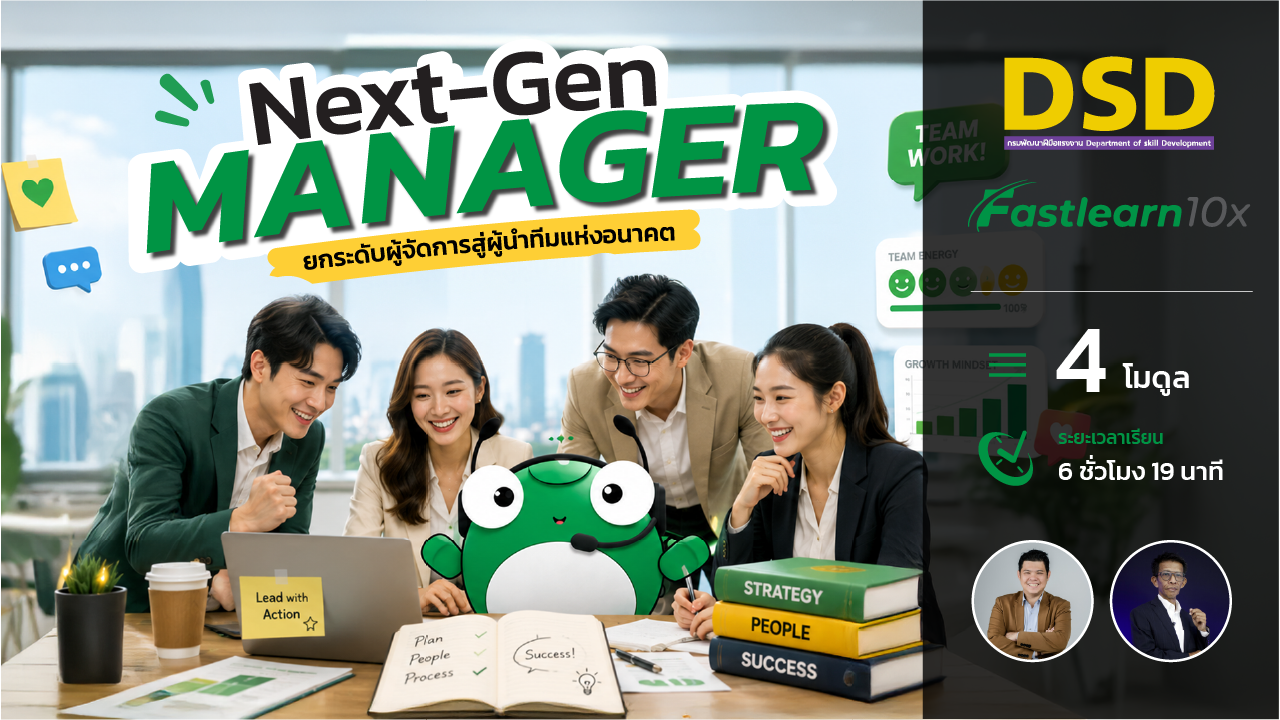
Elevating managers to become future team leaders: Next-Gen Manager.

- Description
- Curriculum
- FAQ
- Reviews
Main instructor:
-
Yotsak Mongkolpanyalerd
-
Wisut Thawornrat

The role of "managers" in the modern workplace is changing dramatically, from a focus on controlling work, giving orders, and monitoring results, to becoming... A team leader who can manage change, develop people, decentralize authority, and build teams that think and make decisions independently.
Many organizations also find that a significant number of managers are promoted based on their job expertise but are not adequately prepared in people management, leading to problems such as: Micromanagement, team members hesitant to make decisions, lack of responsibility, team resistance to change, or managers burdened with solving every problem alone.
At the same time, managers must work amidst uncertainty, new technologies like AI, changing work patterns, and the expectations of younger generations, making traditional management skills alone no longer sufficient.
Elevating managers to become future team leaders (Next-Gen Manager) Therefore, it is designed to develop managers so they can move beyond their roles. “Manager of Work” to “Leader of People” Through four key competencies: Leading Change, Analytical Thinking, Empowering Management and Coaching Leadership
Learners will learn how to lead teams through change, develop analytical and systematic decision-making, reduce micromanagement and increase empowerment, and utilize coaching mindset, active listening, powerful questions, and feedback to enhance team potential.
The goal of the course is to create... Next-Gen Manager Not only can they manage to get the job done, but they can also build a team that... To think critically, make decisions effectively, take responsibility, and grow independently.
This course requires authorization under an organizational contract. Please contact the administrator.
-
1
 Learning materials: Change Management: Strategies and Management of Change.
 -
2
 Lesson 1 : Why to Change - Why to Change
 -
3
Lesson 2 : Seven Truths about Change - 7 Truths about Change
-
4
Lesson 3 : Barriers to Change - Barriers to Change
-
5
Lesson 4: Readiness of Change - Check readiness before change
-
6
Lesson 5 : 8 Stage of Change Management - 8 steps to creating change
-
7
Lesson 6 : Strategy of Change Management - Strategy for creating change
-
8
Lesson 7: Responsible of Change Management - Who plays a key role in change management?
-
9
Lesson 8 : ADKAR model of Change Management - Create a campaign for change with ADKAR
-
10
Lesson 9: Handle to Change
-
11
 Knowledge Checks: Change Management Strategies and Practices


-
12
Learning materials: Smart Work With Analytical Thinking
-
13
Lesson 1: Why Analytical Thinking Important Why Analytical Thinking is an Important Skill in the 21st Century
-
14
Lesson 2: Analytical Thinker What can an Analytical Thinker do?
-
15
Lesson 3 : Improve Your Analytical Thinking Develop your analytical thinking.
-
16
Lesson 4 : 5W 2H For Analytical Thinking Questions that help in analysis
-
17
Lesson 5 : Fault Tree Analysis (FTA) Fault Analysis Tool
-
18
Lesson 6: Risk Analysis Risk Analysis Techniques
-
19
Lesson 7: Probability Probability Analysis Techniques
-
20
Lesson 8 : AAR : After Action Review Joint analysis after action
-
21
Knowledge Checks: Smart Work With Analytical Thinking
-
22
Learning materials: Unlimited Growth by Empowering Management
-
23
Lesson 1: Micro Management - Is this management good or bad?
-
24
Lesson 2 : Directive Vs Supportive - Giving direction or support
-
25
Lesson 3: Empower Management - What is decentralized management?
-
26
Lesson 4: Rebuilding Trust
-
27
Lesson 5: Psychological Safety - Creating a safe space for the mind
-
28
Lesson 6: Delegation with Empower - Delegation with Empowerment
-
29
Workshop : Delegation Planing - Delegation Planning
-
30
Lesson 7: Creative Feed Forward - Techniques for Giving Advice to Create Growth
-
31
Lesson 8 : Empowering Strategy - Decentralization Strategy
-
32
Lesson 9: Summary of Empowerment - Summary of the Heart of Decentralized Management
-
33
Knowledge Checks : Unlimited Growth by Empowering Management

-
34
Download the learning materials: Coaching Mindset for Future Leaders: Unleash Your Leadership Potential with a Coaching Approach.
-
35
Lesson 1: The Changing World of Work
-
36
Lesson 2: Who is a coaching leader?
-
37
Lesson 3: Listen to Hear Potential (Listen Like a Coach)
-
38
Lesson 4: When Questions Become Inner Power
-
39
Lesson 5: How to Coach Effectively (GROW Model)
-
40
Lesson 6: Giving and Receiving Feedback
-
41
Lesson 7: The best coach is yourself (Coaching Yourself in the Age of AI)
-
42
Lesson 8: Becoming a Real-Life Coach-Leader
-
43
Knowledge Checks : Coaching Mindset for Future Leaders
-
Understanding the new role of managers in the future of work.
-
Adjusting the role from... Manager of Work to Leader of People
-
Understand the nature of change and the factors that cause teams to resist change.
-
Assess the team's readiness and develop a strategy to guide the team through the transition.
-
Use the concept. Change Management and the ADKAR Model To support the change.
-
Systematically analyze problems, situations, and risks.
-
Use tools 5W2H, Fault Tree Analysis, Risk Analysis, AAR and First Principles Thinking
-
Reduce the behavior. Micro Management In team management.
-
Understanding when to give direction, when to provide support, and when to empower.
-
build Trust and Psychological Safety To encourage the team to think creatively, ask questions, and make decisions.
-
Assign tasks and decentralize authority appropriately.
-
Increase the responsibility and ownership of team members.
-
develop Coaching Mindset For human resource management and development.
-
use Active Listening To understand the mindset and potential of team members.
-
use Powerful Questions To encourage the team to think and find answers on their own.
-
use GROW Model In coaching to develop employee performance and potential.
-
Give and receive Feedback creatively
-
Create a team development guideline that can be applied to real-world work situations.
-
Middle Manager Middle Manager
-
Department Manager
-
Section Manager
-
Branch Manager
-
Project Manager
-
Team Manager
-
A manager responsible for managing and developing a team.
-
A manager responsible for changes within the organization.
-
A manager who is facing problems. Micro Management
-
Managers who want to increase accountability and ownership among their team members.
-
Managers who want to develop their skills. Coaching and Feedback
-
Senior Supervisor, or a supervisor who is preparing to advance to the Manager position.
-
Project personnel Management Development Program
-
Talent or Future Leaders that organizations want to prepare for managerial roles.
 Obrom, Fastlearn10x's smart assistant.
 Google
  Facebook
 We use cookies to improve the performance and provide a better user experience on our website. You can find more details here. Privacy Policy And you can manage your privacy yourself by clicking on... Set up